Cattlemen's Capitol Concerns
Contact:
Bethany Shively,
The Cattlemen's Capitol Concerns (CCC) is a weekly report from Washington, D.C., giving an up-to-date summary of top policy initiatives concerning the cattle industry; direct from the National Cattlemen's Beef Association (NCBA). Please feel free to reprint in full or in part. If you would like to include NCBA's logo, contact us at 303-694-0305. | |
|
NCBA Urges Congress to Examine the Science in the Discussion of Antibiotics
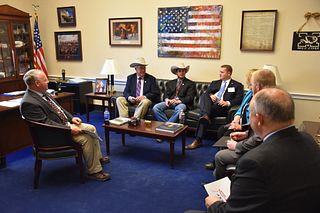
Kansas State University's (KSU) Michael Apley, a veterinary clinical pharmacologist, traveled to Capitol Hill yesterday with the National Cattlemen's Beef Association (NCBA) to educate lawmakers and their staff about the use of antibiotics in the beef industry. Dr. Apley and NCBA met with Congresswoman Louise Slaughter (D-NY) and Congressman Leonard Boswell (D-IA) to discuss H.R. 1549, Rep. Slaughter's bill to ban the use of antibiotics in livestock.
"We appreciate Congresswoman Slaughter taking the time to visit with us today. I'm encouraged by her willingness to sit down for an open discussion and that she has extended an offer for us to be involved in the discussions moving forward," said Apley. "As a veterinary clinical pharmacologist, I work to evaluate the benefits and risks of use of antibiotics in livestock. It's extremely important that data-driven review and analysis be the guiding force behind every decision that affects the care of our animals and the safety of the food we eat."
Rep. Boswell, who also has concerns about H.R. 1549, was part of a recent congressional delegation trip to Denmark to examine the impacts that their antibiotics ban had on the country's swine population.
"In Denmark, we heard from farmers who saw increased mortality and illness, in addition to higher production costs, soon after the ban was put in place," Boswell said. "In fact, many small Danish farmers who raised pigs went out of business after the ban. Only the farmers who could afford to implement the ban did survive the transition."
In addition to the meeting with Reps. Slaughter and Boswell, NCBA held a congressional briefing for staff, where Apley discussed the judicious use of antibiotics in the beef industry as one of the critical tools used to raise healthy cattle. The briefing was part of NCBA's ongoing "Beef 101" series to educate policy-makers about the beef production process, including the industry's commitment to producing the world's safest, most abundant, nutritious and affordable beef supply.
"Unfortunately, there are a lot of misconceptions and outright misrepresentations out there about why and how antibiotics are used in the cattle industry," said Apley. "The truth is, cattle producers and veterinarians utilize many tools including vaccines, herd health management, genetics and animal nutrition to avoid the need for antibiotics.
"They must adhere to strict, science-based guidelines in the use of antibiotics to treat, prevent, and control disease in livestock. These antibiotics have passed a stringent FDA-approval process, which has demonstrated they are safe and effective."
Apley is a KSU veterinary professor, beef cattle veterinarian, fourth generation beef producer, and clinical pharmacologist. He is also a Diplomate of the American College of Veterinary Clinical pharmacology. Apley works with veterinarians throughout the United States concerning the use of medicine in food animals and also in the area of beef cattle-health.
"Prevention of disease is a cornerstone in both human and animal medicine," Apley continued. "Veterinarians and producers are intent on fulfilling their obligations to both human and animal health, and our current regulatory process provides methodologies for further evaluating the use of antibiotics in food animals. It would be a tragedy to lose any valuable tools for preventing animal disease without substantial evidence for a benefit to human health." |
|
NCBA Members Elect Officers, Approve New Policies for 2010
The annual Cattle Industry Convention concluded on Saturday with the National Cattlemen's Beef Association (NCBA) board of directors meeting and annual membership meeting. During the meetings, members voted on leadership and policies to ensure the organization's success in 2010. More than 6,000 people attended this year's convention in San Antonio, Tex.
Steve Foglesong, owner of Black Gold Ranch in Illinois, was officially elected to succeed Gary Voogt as NCBA's new president. Foglesong encouraged NCBA members to join him in leading this great industry-and the association-to an even stronger future, by getting engaged in the issues and telling their story to the public, as well as lawmakers in Washington, DC.
"Our industry has a great story to tell," said Foglesong. "Our numbers may be small, but when each of us engages and makes our voice heard, we are a force to be reckoned with."
During the meeting, members approved a number of policy recommendations to guide NCBA efforts in Washington, DC in 2010.
In the area of federal lands, property rights and land management, members approved policy calling for reform of the Equal Access to Justice Act (EAJA). While EAJA was established by Congress to ensure that individuals, small businesses or public-interest groups with limited financial resources could seek judicial recourse from unreasonable government actions, a lack of federal oversight has allowed the Act to be abused, particularly by environmental-activist organizations which often target farmers and ranchers under the guise of "public interest." In a six-year period, non-profit environmental groups have filed more than 1,500 lawsuits and in turn the federal government has paid out billions in taxpayer dollars in settlements and legal fees under EAJA and other fee-shifting statutes in cases against the U.S. government.
Also with regards to federal lands, members approved policy to address the growing problem of wild horse and burro over-population, which has contributed to range degradation and reductions in biodiversity and livestock productivity. The policy calls for a comprehensive program-including fertility control, sex ratios, and other humane means of herd reduction-in accordance with the management options authorized to be used by the Bureau of Land Management.
With regard to international markets, members passed policy calling on NCBA to urge Congress to immediately ratify the Korea-U.S. Free Trade Agreement (KORUS FTA)-one of the most important bilateral trade agreements in the history of the U.S. beef industry. According to South Korean Economic Minister Choi, who addressed attendees at this week's economic markets committee meeting, U.S. competitors such as Australia are well on their way to finalizing free-trade agreements with Korea, putting U.S. competitiveness at risk for years to come.
In the area of cattle health, NCBA will pursue priorities and strategies regarding both the modification of the National Brucellosis Eradication Program and the eradication of brucellosis from the Greater Yellowstone Area. New policy also directs NCBA to work to maintain producers' ability to keep their cattle healthy through the use of approved antibiotics.
All policies adopted are now subject to approval by more than 30,000 NCBA members nationwide. Convention results will become official after a mail-in ballot process concludes in March.
In other news, former Vice President Bill Donald of Montana was confirmed as the new president-elect, and former Federation Division Chairman J.D. Alexander of Nebraska was elected to succeed Donald as vice president.
Foglesong ended the convention with his outlook for 2010. Despite the very-real challenges facing the industry-including an over-reaching federal government and increasing attacks by activist groups-he said he's optimistic about the year ahead.
"We have a nation of bright and professional agriculturalists who are ready to meet demand when it rebounds. And we have a noble profession: feeding people here at home, and around the world. This is a job and a lifestyle to be proud of and fight for so we can turn a strong industry and industry association over to our next generation." |
|
Members of Congress Make Trade a Priority
In a letter sent to President Obama last week, Senator Johanns (R-Neb.) and 17 cosigners, including Senate Agriculture Committee Chairwoman Blanche Lincoln (D-Ark.), expressed their commitment to help the President meet the goals of doubling American exports over the next five years and ratifying pending trade agreements with Colombia, Panama, and South Korea. The National Cattlemen's Beef Association (NCBA) is pleased that the Administration and members of the Senate are making trade a priority.
Passage of pending Free Trade Agreements will level the playing field for U.S. exports, maintain a competitive advantage for U.S. commodities overseas, and create jobs here at home.
What's at stake under pending FTAs for the U.S. beef industry?
Passage of the U.S.-Korea FTA would mean: a 15-year phase-out on all beef muscle cuts from the current 40% duty; $15 million in tariff savings for beef in the first year of the agreement alone; and once tariffs are completely phased out, an annual savings of over $325 million.
Every day that Congress does not approve the Colombia FTA, American exporters pay $2 million in unnecessary tariffs. Under a U.S.-Colombia FTA, U.S. beef producers would gain: the immediate elimination of Colombia's 80% duty on prime and choice cuts; duty-free access for all remaining cuts through a 2100 ton tariff rate quota; and duty-free access under a 4642 ton tariff rate quota for variety cuts.
Ratification of the Panama FTA would mean the immediate elimination of the 30% duty on prime and choice cuts, and a 15 year phase-out of duties on all other cuts.
In other trade news, more than 20 members of the U.S. House of Representatives sent a letter to Representative Jason Yuan, head of Taipei's Economic and Cultural Office, expressing disappointment with the recent, unilateral decision by Taiwan's Legislative Yuan to bar the import of certain beef products, in direct violation of a recently-signed bilateral agreement. According to the letter, "This unjustified and inappropriate action raises serious questions about Taiwan's continued credibility and reliability as a trading partner." For more information, visit: http://www.beefusa.org/NEWSNCBADenouncesTaiwanBeefTradeRestrictions 39999.aspx
In addition to resolving the issue in Taiwan, NCBA is calling on the Administration to continue efforts to expand access for U.S. beef in Japan and China. Japan's restriction on beef products from cattle over 21 months is limiting us to about 25% of our potential market-which translates to about $1 billion in lost exports annually. China is currently closed to U.S. beef exports, but represents one of the largest potential growth markets for U.S. beef, worth in excess of $100 million. |
Don't Miss NCBA's Cattlemen to Cattlemen!
Don't miss a special LIVE edition of NCBA's Cattlemen to Cattlemen on Tuesday, February 9 at 8:30 p.m. EST. New NCBA President Steve Foglesong, CEO Forrest Roberts and Vice President of Government Affairs Colin Woodall will take questions from callers about the state of the industry, the organization and the outlook for 2010. To ask a question, call in during the show, or submit questions in advance via email. Go to CattlemenToCattlemen.org for more details.
NCBA's Cattlemen to Cattlemen debuts Tuesday at 8:30 p.m. and airs again Wednesday at 10:30 a.m. and Saturday at 9 a.m. (all times are Eastern). Don't forget, you can watch NCBA's Cattlemen to Cattlemen online anytime by visiting CattlemenToCattlemen.org. Follow us on Twitter at NCBA C2C and become a fan of the show on Facebook by searching NCBA's Cattlemen to Cattlemen. | |
NATIONAL CATTLEMEN'S BEEF ASSOCIATION
1301 Pennsylvania Avenue NW, Suite 300 Washington, D.C. 20004 | | Cattlemen's Capitol Concerns - January 21, 2010 (1/21/2010) Cattlemen's Capitol Concerns - January 14, 2010 (1/14/2010) Cattlemen's Capitol Concerns - January 7, 2010 (1/7/2010) Cattlemen's Capitol Concerns - December 17, 2009 (12/18/2009) Cattlemen's Capitol Concerns - December 10, 2009 (12/10/2009)
|
|